Showing posts with label Scott Kolins. Show all posts

Thursday, April 30, 2020

Watching the Walmart Giants 10 “April 2020, with Jim Lee!”

Apparently I hadn’t been to Walmart since the beginning of the month when I made the trek last weekend. I didn’t really expect new giants to have shipped, but they had! Including one that had received a fair amount of press, for these giants, because it features new Jim Lee art, which is:

Our Fighting Forces 100-Page Giant #1

  • The first story is from Christopher Priest & Christopher Mooneyham, featuring the Unknown Soldier. I don’t read a lot of DC’s war comics, usually, but I at least knew about this character. As he’s prone to, Priest sells the hell out of the concept, making Unknown Soldier feel like a fresh and compelling concept. I’d read Priest’s Unknown Soldier monthly, easily!
  • The second is from G.I. Joe legend Larry Hama with Mirko Colak, featuring military-era Kate Kane (Batwoman), a modern character who absolutely deserves all the attention she gets.
  • The third is Jim Lee’s, with a script from Brad Meltzer based on a speech Barack Obama gave awarding Sal Giunta with the Medal of Honor. Lee spends most of it drawing Batman, but that’s because it’s clever enough to swerve the reader with a story of real heroism juxtaposed on a typical superhero adventure. Absolutely stunning.
  • Then five reprints from the New 52’s Men of War, with the highlight coming in last from J.T. Krul & Scott Kolins, featuring a soldier post-war finding it difficult to get a job, eventually ending up in an interview where he’s upstaged by some former local football star...It’s incredible to think how poorly vets are treated, regardless of how you feel about the wars they’ve fought. They deserve a helluva lot more. Kolins, whose art can sometimes be a little weird, turns in some career-best material. This whole issue is outstanding.
Superman 100-Page Giant #3

  • The first story is from Robert Venditti & Paul Pelletier, featuring Superman caught in the crossfire between Lex Luthor and Toyman, who’s trying to redeem his toy company after it’s been acquired by Luthor. Pelletier turns in sharp work, arguably the best I’ve ever seen from him, and he’s someone who’s been working in comics since the ‘90s!
  • Reprint of Supergirl #56, featuring Bizarro.
  • Reprint of Action Comics #868, part of Geoff Johns & Gary Frank’s excellent Brainiac arc.
  • Reprint of Action Comics #0, the exceptional “Boy Who Stole Superman’s Cape,” which single-handedly makes a mockery of fans who dismissed Grant Morrison’s run in the New 52.
Titans 100-Page Giant #2
  • New from Phil Hester & Scott Koblish, featuring a Titans team with Red Hood.
  • New from Andrew Aydin & Juan Gedeon, featuring Beast Boy & Raven, and once again Red Hood, that’s about halfway to the storytelling style of Teen Titans Go!
  • Reprint of Teen Titans #51, from 1977, featuring two teams of Titans, continuing where the last giant left off.
  • Reprint of Starfire #2
  • Reprint of Adventures of the Super Sons #2, which kind of emphasizes Tomasi really just wanted to have fun for a change.

Monday, June 5, 2017

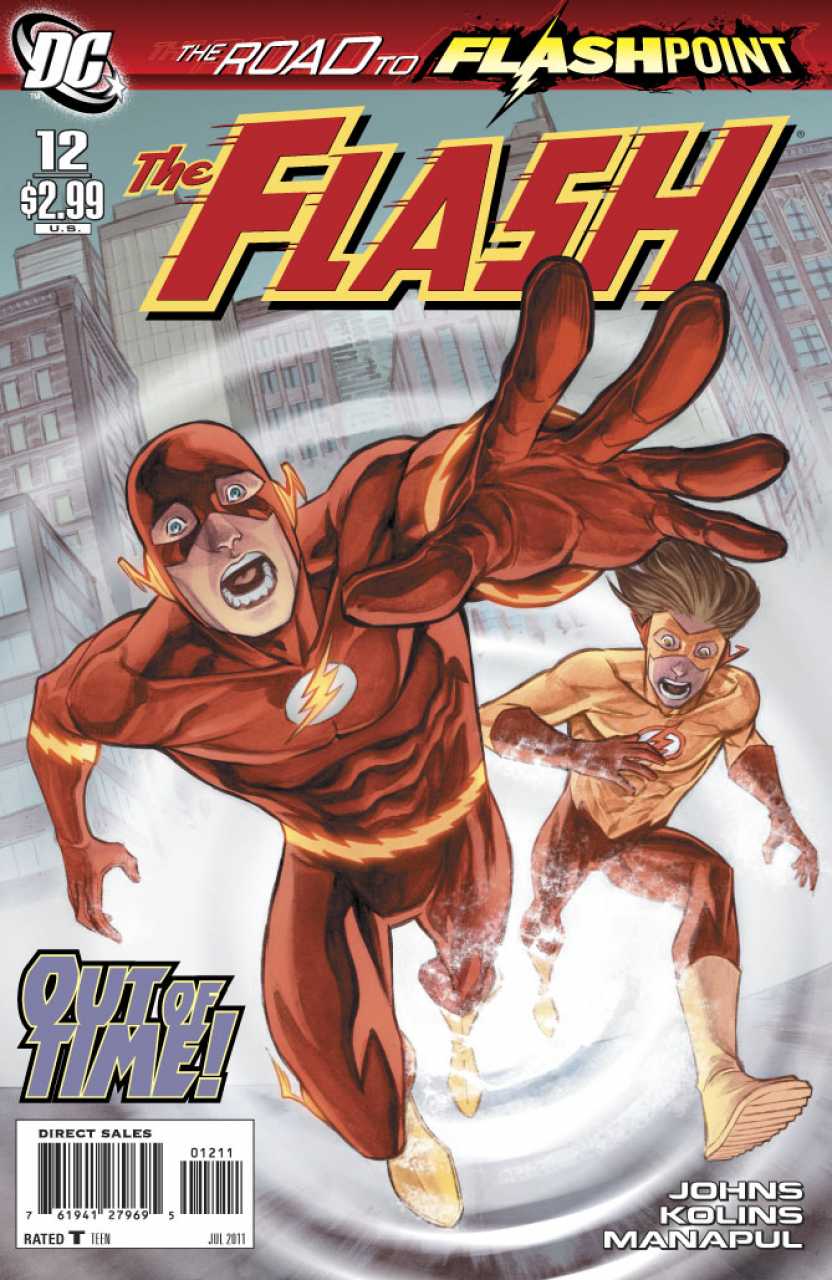
Quarter Bin 102 "Road to Flashpoint"


Flashpoint was a seminal comics moment for me, and it remains one of my happiest memories and favorite stories.  I'd been bummed that Geoff Johns started writing The Flash again, only to end after twelve issues, but I never got to finish reading those issues until now.  Of course, I was happy once I read Flashpoint, and even happier about his New 52 work (Justice League and Green Lantern were highlights of many a year), so I gave up being upset that these were the final issues.

The Flash #10-12 (DC)
from June, July 2011.

Drawn by Scott Kolins (who'd done a lot of Johns's Wally West Flash series) and Francis Manapul (who'd launched this one with Johns, and would lead the New 52 reboot), these are "Road to Flashpoint" stories that teased a character called Hot Pursuit, who turned out to be Barry Allen from an alternate reality (he probably needs to return at some point, despite his fate here), only to feature the return of Eobard Thawne, the Reverse-Flash, ahead of his role in Flashpoint.

There's a strong emphasis on Bart Allen who I enjoyed reading so much in the '90s as Impulse but who Johns transformed into Kid Flash in the pages of Teen Titans, which was nice.  The new 52 version of the character totally revamped the concept, which angered a lot of fans, but I never let it bother me.

Ironically, this was the last time DC had letters in its comics, and in the last two issues apparently Flash finally joined the bandwagon, only for the idea to go away again and never (so far) return.

Monday, March 16, 2015

Reading Comics 155 "Blasts III"

I went sifting through recent back issues again...

Catwoman #27 (DC)
Detective Comics #28 (DC)

I've been obsessed with trying to track down "Gothtopia" issues since Detective Comics #27 was released last year with (among a lot of excellent content) John Layman's kickoff for the arc.  It turned out to be a Scarecrow story, but its look at a hopeful Batman and surrounding family, including Catwoman, who was dubbed Catbird, complete with a costume update mixing in elements of Robin's traditional look (that cover is from the Dodsons).  Either I've been overlooking that one copy of Detective 28 or I don't know, it spontaneously appeared in bins I've been rifling for months now.  Previously, elsewhere, I found the conclusion of the arc, so it's a nice bonus to fill in some of the gaps.

This is the first New 52 Catwoman I've read, and the first Catwoman, really, since the '90s (in the height of the Jim Balent era featuring a costume and anatomy that in hindsight really makes very little sense for the character).  I'm glad I read the Detective issue, too, as it connects all the cerebral dots and may actually be the finest Batman I've read from Layman.

Jim Henson's The Storyteller: Witches #1 (Archaia)

Based on a short-lived TV series the late creator of the Muppets launched in 1988, this is fairy tale storytelling in the manner of the Brothers Grimm and Hans Christian Anderson.  As represented by S.M. Vidaurri, who writes, draws, and letters in an exquisitely imaginative manner, this is an excellent bid to once again expand Henson's legacy.

Vidaurri also happens to present a tale that fits right in the current trend of strong female protagonists in fantasy, featuring a young princess who cleverly solves the riddle of her brother's disappearance and the only way to avoid the curse that had been meant to be leveled against their father.

The page I've reproduced on the left is one of the easier to follow.  Most of the pages require a little more scrutiny than readers are probably used to employing.  Some of the best creative work I've seen in comics.

Larfleeze #8, 9, 10, 11, 12 (DC)

The final five issues of the series that I greedily (finally!) snatched up.  When the series was still being published, for whatever reason I skipped over it month after month.  What a dastardly shame!  But seriously, Larfleeze was likely always a short-term proposition, especially given how its main character by definition plays extremely hard to play with.  Unless you're G'Nort.  Which, by the way, is pronounced "Nort," not "G Nort," which is what idiots like me have been doing for years, even with occasional correction.  G'Nort is infamously the most pathetic Green Lantern ever, and so of course is the other one famously featured in Keith Giffen and J.M. DeMatteis's Bwa-ha-ha League comics (one clue as to the other: "One punch!").

Finally pairing Larfleeze with G'Nort is just one of the brilliant repositioning moves Giffen and DeMatteis make in these final issues.  They also find Larfleeze a bride, Sena the Wanderer, part of a pantheon about as pathetic as everyone else in the series.  Anyone brave enough to tell Larfleeze stories in the future would be wise to keep all three (plus hapless butler Stargrave!).  The key to telling a good Larfleeze story is to keep him in adequate context (*cough* Deadpool writers), which this series nailed.

The art from Scott Kolins rendered the misadventures with all the dignity absolutely no one deserved, by the way.

MIND MGMT #1, 19, 24 (Dark Horse)

You know how you can hear how awesome something is a hundred times, not really pay attention, and then all of a sudden you give it a real chance and you totally get it?

That's what happened here.

Okay, so technically someone pulled a dirty trick, too, perhaps some mind management (that's the title of the series without abbreviation, by the way; honestly not knowing exactly what that was had been one of my main stumbling blocks), when I looked at the letters column in #19 and saw how Matt Kindt have been advocating Roberto Bolano's 2666.  I love that book.  Subsequently, when I see that someone else has discovered its brilliance, and has been actively recommending it, that's an excellent way to get in my good graces.

The three issues I sampled were more than enough to see that MIND MGMT is special indeed.  It's a little like if J.J. Abrams had combined Alias and Lost (Fringe comes close, actually), about a team of government operatives formed in the wake of Franz Ferdinand's assassination, a story ripe for an era where spying has once again gripped the public's imagination (for dubious reasons, alas).  And it's a story that unfolds more quickly than you might think.  The first issue introduces Meru, a desperate writer looking for her last lifeline and finding it in the anniversary of a flight that became known for every passenger suddenly coming down with amnesia.  All except one (the Henry Lyme seen and referenced on the cover of #24 seen above).  At this point you might expect an Orson Welles story, but Kindt quickly produces Lyme, and the story only becomes deeper from there.

And I've only read three issues.  And you want to know the most insane part of this whole thing?  There are only a half dozen issues remaining!  So I've caught the bug just in time, haven't I?  This happened to me with Y: The Last Man, too, only I was able to follow about the last year of that series.
Next time I'm at the shop, I'll be picking up more issues.  And hopefully catching the rest of the series.

Sunday, January 11, 2015

Reading Comics 145 "Justice League"

via Nothing But Comics
I've been a huge supporter of Geoff Johns' Justice League, but you'd be forgiven for not knowing that, as I haven't regularly read it in a few years.  I haven't even finished reading "Throne of Atlantis," which should be indication enough of how that's played out.

Since Forever Evil, I've been making an effort to get back into it.  The problem hasn't been the series itself, unless you count the fact that Justice League has consistently been one of the must-read-monthly series since it debuted in 2011.  What happens when you don't read monthly?  Pretty much what happened to me.

What brought me back?  In a word, Luthor, as in Lex Luthor, who has officially joined the team.  And don't think that's been easy.  I've recently read #34-36, the conclusion of the initial post-Evil arc and the start of "The Amazo Virus."

Luthor isn't the only new phase.  Recent issues have included Jessica Cruz, who Johns first introduced in Green Lantern #20.  Cruz is another legacy of Evil, who has gained possession of the alternate universe Power Ring's eponymous weapon, which like everything else from that reality has an evil bent.  Cruz has been terrified, but has shown an ability to overcome, so to speak, great fear.  She has supplanted Simon Baz as Johns' continuing link to Green Lantern lore, and the opportunity is hardly lost on him.

Interesting, at least in the pages of #34, he's also chosen to continue another legacy, the heroic alliance between Green Lantern and The Flash.  Green Lantern may be in a wholly different incarnation, but Flash is once again Barry Allen.  Johns tends to write the series pairing characters together in separate storylines, which was how a Green Lantern first appeared in its pages, alongside Batman (a genius combination that could really use additional exploration).  That's also how Superman/Wonder Woman happened, by the way.

The issue also sees Johns collaborate, once again, with Scott Kolins, with whom he's done many Flash stories before.  This was great to see, and Kolins, as always, didn't disappoint.

Wonder Woman and Luthor, Luthor and Bruce Wayne, Luthor and Owlman?  Of course Lex Luthor remains hugely important to the series.

#35 sees the rivalry between Luthor and Wayne (which is all in Luthor's head, naturally) continue, with competing public speeches that further illuminate both characters.  Most of the issue is about them, actually, incidentally introducing the next big arc when Luthor's fail-safe weapon is accidentally unleashed.  I admit I wasn't initially interested in jumping back into Justice League at this point because I wasn't sure how interesting "Amazo Virus" would be, but eventually I realized it's a variation on a subplot from 52, which Johns worked on with Grant Morrison, Greg Rucka, and Mark Waid.  It now seems that Johns may have been the spearhead behind that particular element.  This version, and my love of 52 is surely well-documented, may be more interesting, even if the main benefit of the original was finally creating a Luthor/Steel rivalry.

The art for this issue is from another frequent Johns collaborator, Doug Mahnke.

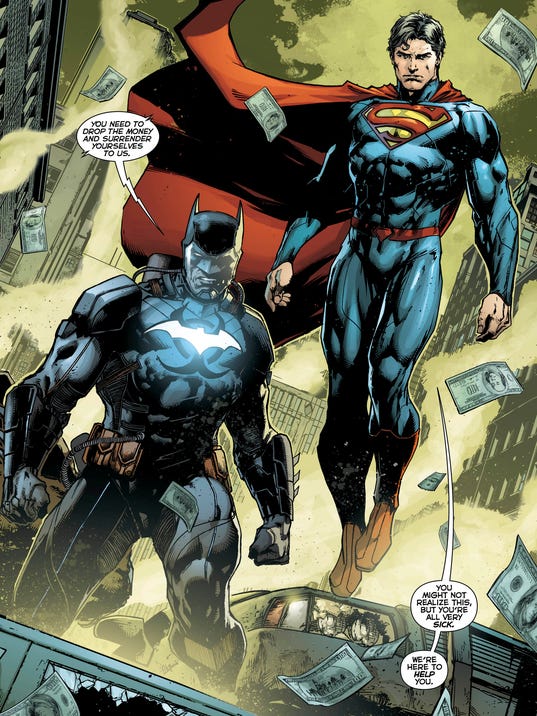
#36 is the official start of the arc.  Before I get to its story contents, let's just acknowledge the art, which is from Jason Fabok, who comes from a Batman background to provide dynamic new art for a series that began with Jim Lee.  
via USA Today
I'v including two pieces of Fabok art, rather than feature Kolins or Mahnke mostly to put a definitive spotlight on Fabok, who here makes a strong case for superstar status.

Johns pairs Superman and Batman (I haven't read the current Batman/Superman, so when I say that hasn't happened enough recently, that's where it's coming from), and Luthor and Wonder Woman once again, which leads to this choice exchange:

Luthor: She's a god. 
Wonder Woman: Why does that sound like an insult when you say it?

Priceless, and another clear instance of Johns nailing the Amazon's perspective in ways other writers haven't even considered.  

I haven't mentioned Captain Cold yet, but his scenes with Luthor across these issues are another highlight, and like Kolins another link to Johns' days writing The Flash.  Every character has a purpose, and a well-defined one, in Johns' scripts, which isn't often the case when a writer is juggling a large cast, whether in a team book or otherwise.  The temptation is always to just throw everyone in the same scenes and have them make random characteristic comments (this is one of my main beefs in Marvel comics).  I prefer more personal depictions.  Somehow Johns does that and keeps the stories big.  That's why Justice League is so important.

So, very profitable return to the series for me.